 Knowledge Base
 发布时间:
2015-10-09
发布时间:
2015-10-09
LED Heat Dissipation
Addressing heat dissipation is central to the design of LED lighting products.
Regarding Thermal Resistance
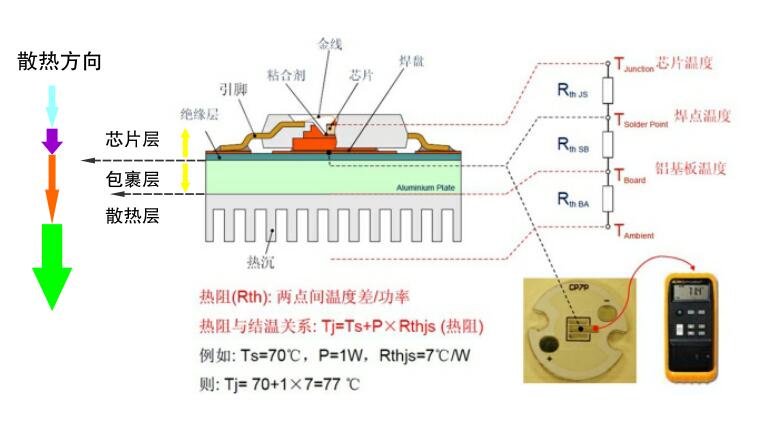
Thermal resistance is a comprehensive parameter reflecting a material's ability to transfer heat. Measured in °C/W, it represents the temperature difference across a thermal path when 1W of heat is continuously transferred. Different materials exhibit varying thermal conductivities; each possesses its own thermal conductivity coefficient. Higher thermal conductivity correlates with stronger heat transfer capability. The total thermal resistance of an LED is the sum of the thermal resistances within and outside the chip. Beyond the thermal conductivity coefficients of each layer, the total thermal resistance also depends on the tightness of the bond between layers. If the layers are not tightly bonded, heat conduction will be impeded.
Heat dissipation area
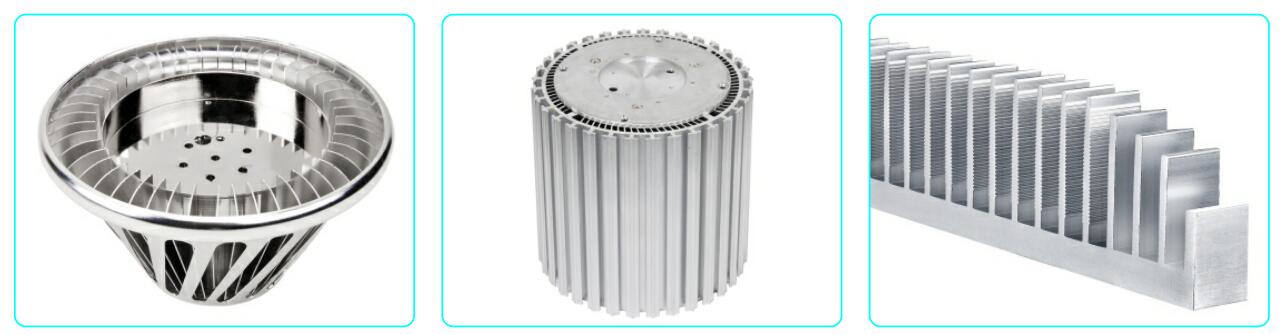
Thermal resistance is also related to the heat dissipation area—the larger the heat dissipation area, the better the heat dissipation.
Principles of Convective Heat Transfer
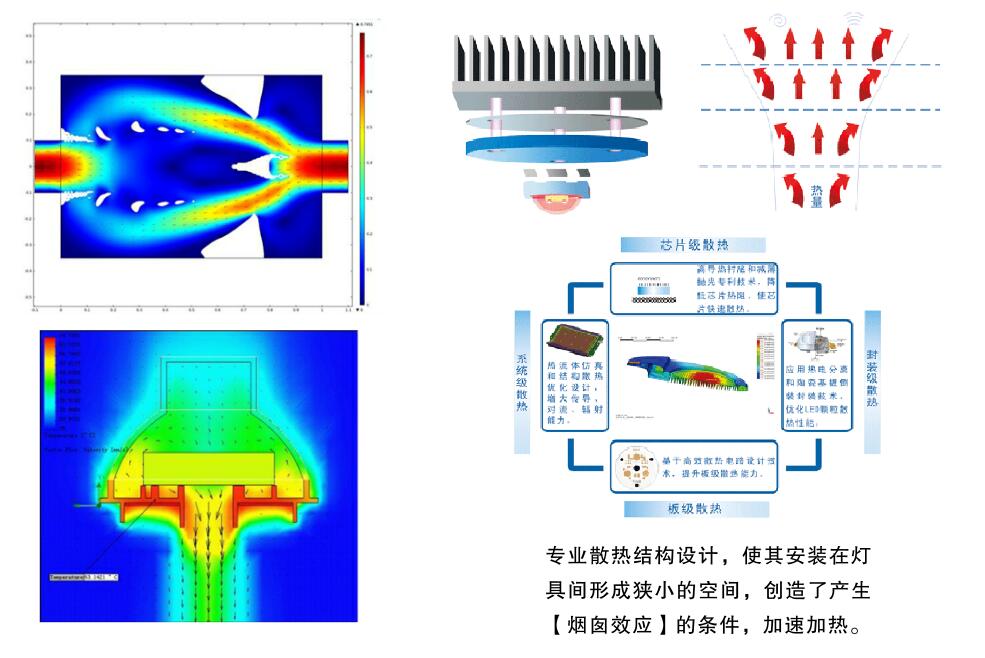
Through rational and scientific structural design, heat dissipation components in LED lighting products utilize the principles of convective heat transfer to accelerate heat dissipation from LED light sources. Convective heat transfer employs the thermal convection principle known as the “chimney effect” to enhance heat dissipation from LED lighting products and reduce their operating temperatures. Practical evidence demonstrates that LED light sources employing this technology exhibit more stable operational performance.
Chimney Effect: The phenomenon where air within a space rises or descends along vertical slopes, intensifying convection currents, is termed the chimney effect. The chimney effect manifests in buildings or structures with chimney-like characteristics—such as shared atriums, vertical ventilation ducts (smoke exhaust ducts), or stairwells—where unobstructed vertical airflow exists from base to summit. Here, air (including smoke) rapidly disperses or exhausts through these passages driven by density differentials. The chimney effect principle is an extension of the pressure principle.